
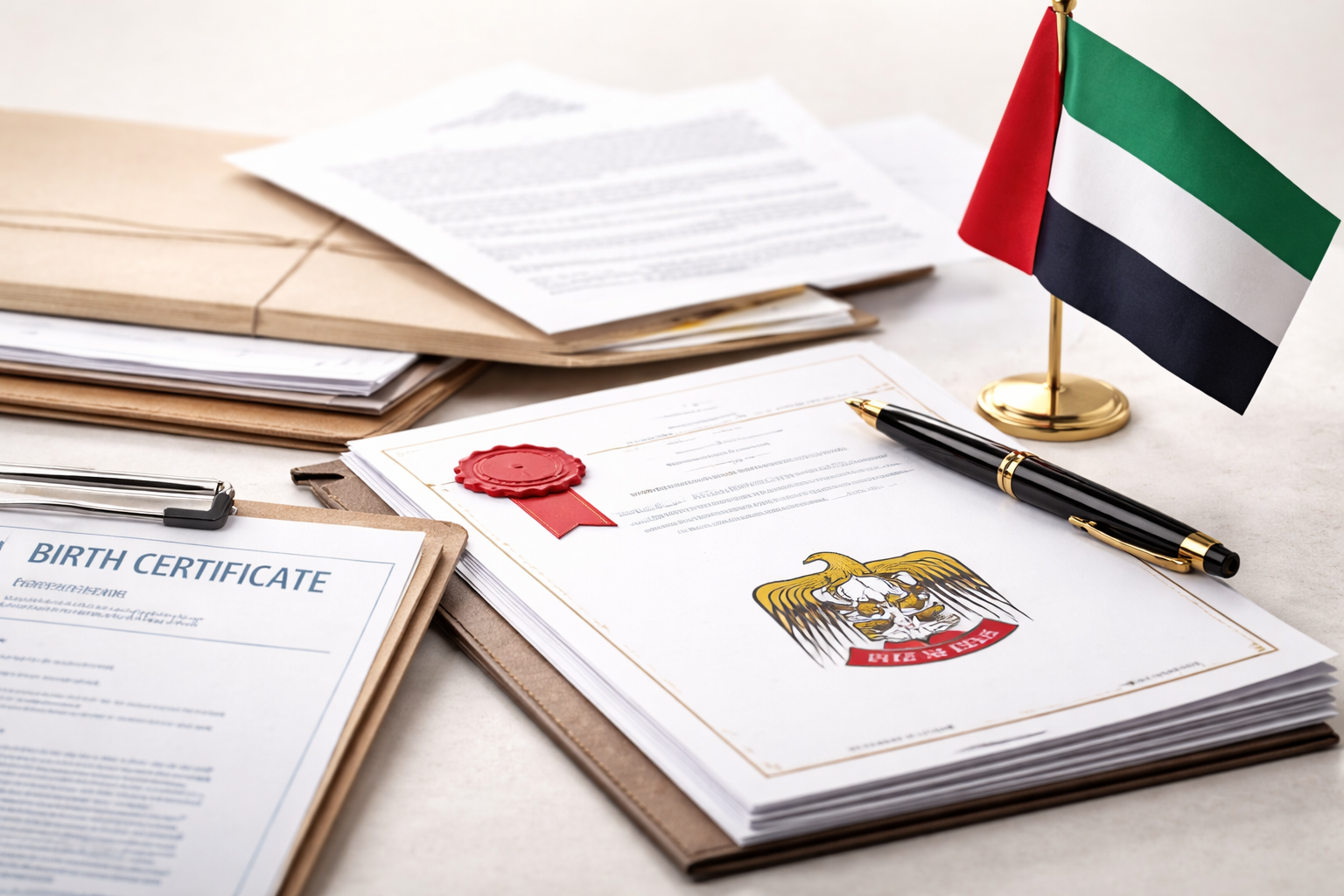
Legalization of Birth Certificates for Use in the United Arab Emirates
The legalization of birth certificates is a mandatory procedural requirement for individuals who intend to use foreign-issued birth certificates for official purposes in the United Arab Emirates (UAE). This process ensures that the document is formally recognized by UAE authorities and complies with applicable legal, consular, and administrative standards. Birth certificate legalization is commonly required for residency applications, family sponsorship, school enrollment, nationality-related procedures, and other civil matters governed by UAE law.
Legal and Regulatory Context
The United Arab Emirates requires foreign public documents, including birth certificates, to undergo formal legalization before they can be accepted by UAE governmental entities. This requirement is based on UAE consular regulations and international diplomatic practices governing cross-border document recognition.
While some countries are parties to the Hague Apostille Convention, the UAE does not rely solely on apostille certification for foreign documents. As a result, documents intended for use in the UAE must generally complete a full consular legalization process, culminating in legalization by the UAE Embassy or Consulate with jurisdiction over the country of document issuance.
Role of the UAE Embassy
The UAE Embassy serves as the final consular authority in the legalization chain for birth certificates issued outside the UAE. Its role includes:
Verifying the authenticity of prior attestations
Confirming that the document complies with UAE legal and consular standards
Legalizing the document for official use within the UAE
The embassy does not issue birth certificates, amend document content, or provide legal interpretation beyond procedural verification.
Birth Certificate Legalization Procedure
The legalization process typically follows a multi-stage sequence, which may vary slightly depending on the country of origin. In general, the procedure includes the following steps:
Step 1: Issuance by the Competent Authority
The birth certificate must be issued by the official civil registry or government authority in the country of birth.
Step 2: Local Authentication
The document must be authenticated by the relevant local authority, such as:
Ministry of Health
Civil Affairs Office
State or provincial authority (where applicable)
Step 3: Foreign Affairs Authentication
Following local authentication, the birth certificate must be authenticated by the Ministry of Foreign Affairs (or equivalent authority) in the country of issuance.
Step 4: UAE Embassy Legalization
Once authenticated by the local foreign affairs authority, the document is submitted to the UAE Embassy or Consulate for final legalization.
Step 5: UAE Ministry of Foreign Affairs (MOFA) Attestation
After arrival in the UAE, the legalized birth certificate may be required to undergo additional attestation by the UAE Ministry of Foreign Affairs, depending on the purpose of use.
Types of Birth Certificates Covered
UAE Embassy legalization applies to officially issued birth certificates, including:
Standard civil birth certificates
Long-form birth certificates
Government-issued extracts or certified copies
Hospital-issued birth notifications or unofficial documents are generally not accepted unless converted into an official civil document by the issuing authority.
Authentication vs. Legalization
It is important to distinguish between authentication and legalization:
Authentication confirms that a document has been issued or certified by a recognized authority in the country of origin.
Legalization is the formal confirmation by the UAE Embassy that the authenticated document is acceptable for use under UAE jurisdiction.
Authentication alone does not authorize a document for use in the UAE without embassy legalization.
International Recognition and Use in the UAE
Once legalized by the UAE Embassy and, where required, attested by the UAE Ministry of Foreign Affairs, a birth certificate may be recognized by UAE authorities, including:
Immigration and residency departments
Courts and judicial bodies
Educational institutions
Government ministries and departments
Recognition is subject to the specific requirements of the requesting authority.
Practical Guidance
When preparing a birth certificate for legalization, applicants should consider the following:
Processing timelines vary depending on country, authority, and document completeness.
Fees are determined by consular regulations and may vary by location.
Submission requirements typically include original documents and, in some cases, photocopies.
Incomplete authentication chains are a common cause of delay or rejection.
Compliance and Validity Notes
Applicants must ensure that:
All names, dates, and details are consistent across documents
Any required translations are certified and accurate
The document has not been altered, laminated, or damaged
The birth certificate meets validity requirements set by the receiving UAE authority
Discrepancies or inaccuracies may result in rejection or additional verification requirements.