
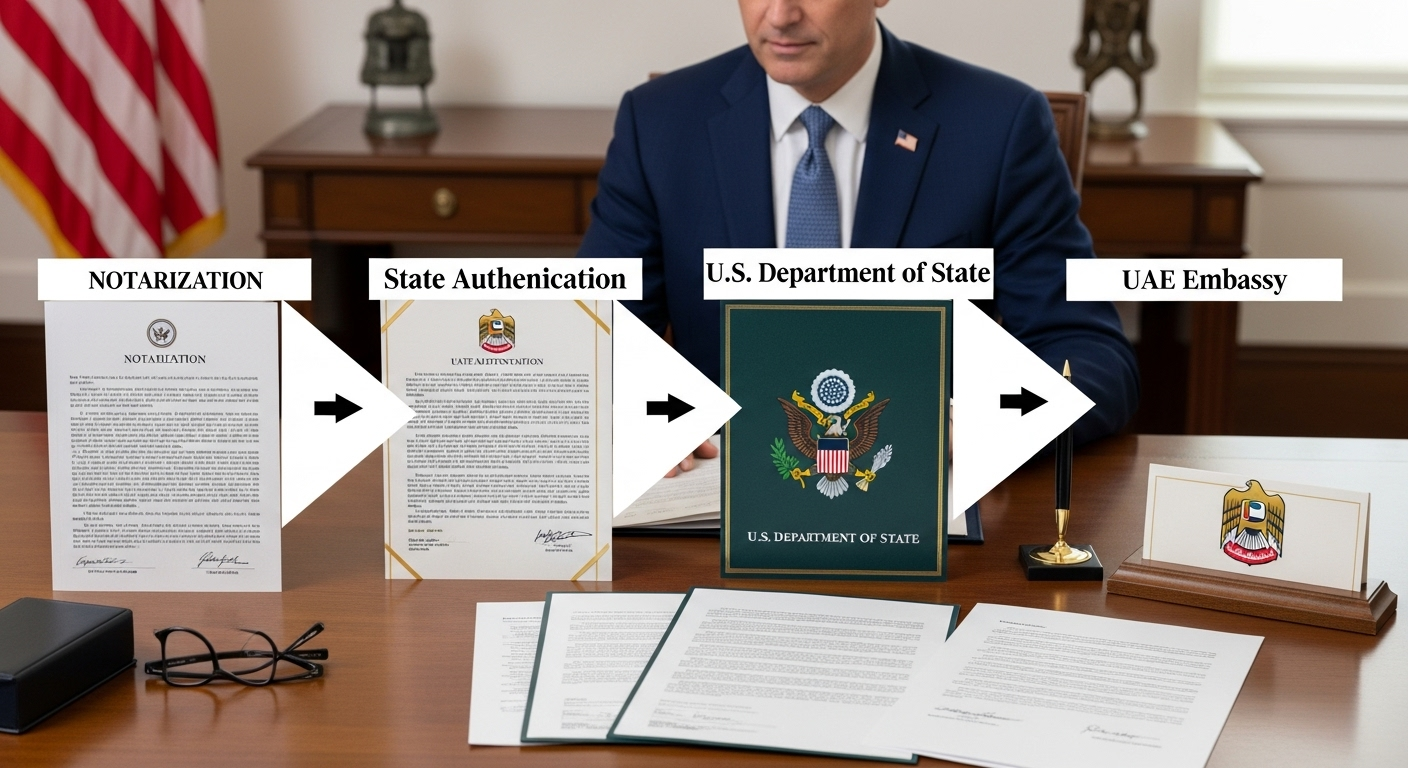
Understanding the Legalization Chain: Notary → State → U.S. Department of State → UAE Embassy
Proper document legalization for use in the United Arab Emirates (UAE) requires a systematic verification process. Documents issued in the United States must pass through several authentication stages to ensure they are officially recognized by UAE authorities.
The UAE Embassy in Washington, D.C., in coordination with the Arab Chamber of Commerce, ensures that all documents follow this legalization chain accurately, providing individuals and businesses with reliable guidance.
Step 1: Notarization
The first step in the legalization chain is notarization. A licensed U.S. notary public verifies the authenticity of signatures and the legitimacy of the document. Notarization confirms that the document is properly executed and prepared for further authentication.
Key Points:
Required for most personal, educational, and corporate documents
Confirms the authenticity of signatures
Prepares documents for state-level certification
Step 2: State-Level Authentication
After notarization, the document must be certified by the Secretary of State in the state where it was issued. This stage ensures that the notary’s authority and signature are valid and recognized at the state level.
Benefits of State-Level Authentication:
Verifies notary authority
Confirms document legitimacy before federal processing
Provides an official state seal required for UAE Embassy legalization
Step 3: U.S. Department of State Authentication
Following state certification, documents undergo authentication by the U.S. Department of State. This federal authentication confirms that the document and prior state-level certifications are valid.
Key Aspects:
Validates notarization and state certification
Ensures compliance with international standards
Prepares the document for UAE Embassy review
Step 4: UAE Embassy Legalization
The final stage is submission to the UAE Embassy in the USA. The embassy reviews all previous authentication steps, examines signatures and seals, and applies its official stamp or seal to confirm the document’s validity for use in the UAE.
Purpose of UAE Embassy Legalization:
Ensures full recognition of foreign documents by UAE authorities
Confirms compliance with UAE legal and administrative standards
Protects individuals and businesses from invalid or unverified documents
Documents Following the Legalization Chain
Personal Documents:
Corporate and Commercial Documents:
Following the complete legalization chain guarantees that these documents are officially recognized in the UAE.
Benefits of Understanding the Legalization Chain
Provides clarity on the steps required for UAE document legalization
Prevents errors or omissions that could cause delays
Ensures compliance with UAE Embassy requirements
Protects legal, educational, and business interests in the UAE
Understanding this chain allows applicants to prepare documents efficiently and avoid unnecessary administrative complications.
Role of the Arab Chamber of Commerce
The Arab Chamber of Commerce assists applicants by:
Reviewing documents for compliance with UAE legalization requirements
Coordinating notarization, state, and federal authentication
Submitting documents to the UAE Embassy for final legalization
This guidance ensures that each document successfully passes through the complete legalization chain.
FAQ
Why is the UAE legalization chain necessary?
The UAE requires verification at multiple levels to confirm the authenticity of foreign documents and prevent fraud.
Do all documents follow the same chain?
Yes. Personal, educational, and corporate documents all follow the same notarization → state → federal → UAE Embassy process.
Can documents from Apostille countries bypass this chain?
No. Even Apostille-certified documents must undergo UAE Embassy legalization for official recognition in the UAE.
How long does the entire legalization chain take?
Processing times vary depending on state, federal, and embassy workloads, typically ranging from several days to a few weeks.